

Background
This project was sponsored by Namaska Lithium which owns the Whabouchi property in northwestern Quebec, Canada. Wahbouchi is a spodumene-based lithium deposit. Lithium is currently a critical element in the production of batteries for a variety of electronics, electric cars and other forms of energy storage.
Questions
- Can ore preconcentration be used to improve project economics?
- Can pilot plant results match the bench-scale results?
- Can a product of 5.8% LiO2 be generated by dense media separation?
Methods
Heavy liquid separation was used for bench-scale separation with specific gravities from 2.65 to
3.00
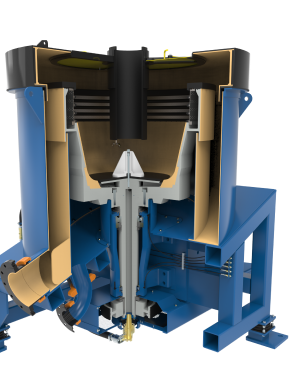
Sepro’s Condor Dense Media Separator was used for three pilot plant tests
Tests were performed using 2 and 3 stages of separation
Medium densities ranged from 2.7 to 3.0
Procedures were varied to maximize recovery as well as product grade
Results
Bench scale tests showed that 91% of the lithium oxide could be recovered in 37% of the mass at an SG of 2.72
The grade-recovery curve of the pilot plant was within 2-3% of the bench scale tests
34% of the lithium oxide could be turned into a product grading 5.9% LiO2 using only one preconcentration step. This could be further upgraded using magnetic separation.
Based on these results, Nemaska determined that it can process more than two-thirds of its ore by only using dense media separation to obtain high-quality concentrate with grades exceeding 6% Li2O at relatively low cost.
 matthew
 2 MINS READING TIME